Friday, May 11, 2012

How Had I Not Seen This Movie!? Part 11: Kiss Me Deadly

Kiss Me Deadly


Kiss Me Deadly is a fantastic film. I went in knowing almost nothing about it, except that it was a quintessential film noir and was also the inspiration for the famous Glowing Briefcase in Pulp Fiction. It begins with standard fare, Private Eye Mike Hammer (Ralph Meeker), picks up a hitchhiker (Cloris Leachman in her debut role) who says she escaped from a mental hospital. Eventually, thugs catch up to them and when Mike wakes up, the hitchhiker is dead and he's been in the hospital for quite some time. Being a private eye, Mike can't help but try to solve the mystery of why those men were after her, despite the trouble it starts costing those around him. 

The film surprised me in just how exciting it ended up being. What began as a normal noir tale ended in one of the more thrilling endings I've seen from a movie released in the 1950s. Similar to Hitchcock's Notorious from a decade early, it takes a basic thriller plot and blends it with the current fears of nuclear attacks. Only Kiss Me Deadly takes it a few wonderful steps further by making it more of a science fiction yarn than just basic bad guys out to make atomic bombs. I highly recommend checking this out.

You're Welcome,
Dave

Valuable Life Lesson Learned: Never open the box.

Upcoming Titles:
- Carlito's Way
- To Catch a Thief
- Body Double
- Battle Royale

Thursday, May 10, 2012

Important Movies Part 1: Pulp Fiction


Welcome to the first in a new series for Dave's Constant. I still plan on keeping the focus on movies that I go back and finally see, but I thought it might be fun to throw one of these up now and again. This series will be a little more personal as they won't focus on the movie itself. Instead, I wanted to share how I discovered some of the films that are most important to me as a movie geek. An important movie can mean many things. To me, it's the films that had the biggest impact on my life, whether as a life changing moment (2001: A Space Odyssey) or simply for the fact that it led me down a path I have since never left (Scream). These aren't the best movies ever made (and not even my favorite). They are simply a collection of the ones that have helped mold me into the person I am today. I hope you enjoy.

Pulp Fiction

    I distinctly remember the first time I saw Pulp Fiction. Well, not the whole movie, but a part of it. I was about 9 or 10 years old and I was at my Grandparents' house. They had one of those TV black boxes* so I typically would see what movies were on Pay-Per-View when I was there to help pass the time. (It was either that or play with their electronic poker machine. They may have had a gambling addiction.) At that age, I would be on the look out for two types of movies, dumbed down comedies for kids or anything that had the possibility of including a boob.** I knew about Pulp Fiction and figured it had a pretty good chance of passing my second criteria for movies. 

    Now before the onDemand days, the Pay-Per-View channels were setup so one channel would play the same movie on loop all day. So my plan was to wait until I was alone and "mistakenly" flip to that channel, hoping to see something cool.  When that time finally came, I put the channel on hoping to see something that explained why so many adults were talking about this movie. What I ended up seeing was John Travolta jamming a giant needle into some woman's chest. What the hell!? I had no idea what to do. I changed the channel back, but I couldn't stop replaying the image in my head. What was this movie anyway? Was it some weird sex scene I didn't understand yet? Was he killing that woman? The only thing I knew was the I wanted to see the rest of the movie.


    Unfortunately, that moment didn't happen for quite some time. I sadly can't even pinpoint the first time I finally got to see the movie from beginning to end now. It was surely well before I could appreciate it though. However, I have seen it multiple times since and easily consider it one of my favorite movies of all time. In high school, Pulp Fiction was the movie that really became the jumping off point as far as me becoming a movie geek for life. At the time, it simply meant watching all of the current movies that were out in theaters, but as I grew older, that love grew into something much bigger. Now, I view movies as something much more important than a simple 90 min. mental break. Movies are now a part of my everyday life. I like thinking that the seed for all this was seeing John Travolta shove that needle right into Uma Thurman's chest.


    You're Welcome, 
    Dave

    *Please don't arrest my entire family!

    **Side note: This was also around the age where I would get excited every week to get the TV guide so I could figure out what movies on HBO had "N" or "AC" next to their titles. I would usually get excited but then not be able to stay awake that late to see the movie. I had a sad childhood.

    Thursday, April 26, 2012

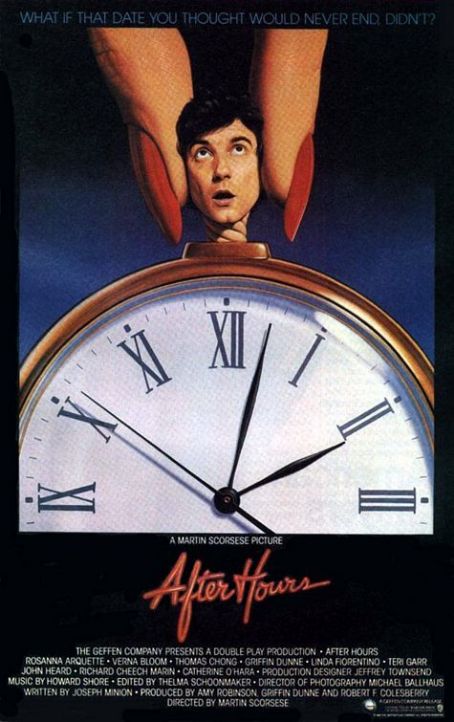
    How Had I Not Seen This Movie!? Part 10: After Hours

    After Hours

    After Hours feels like some mad experiment in filmmaking. It's very rough around the edges and never really seems to find solid footing, but I have to admit that I loved pretty much every minute of it. While on the surface, the movie is about a man who just wants to go home and sleep, it has far too many quirks to be boiled down in such simple terms. To me, the movie is about nightmares, literally. I view the whole film as a dream sequence for Paul Hackett (Griffin Dune). There are far too many links between each section of the movie to be seen as some simple "bad night." Instead, every obstacle that Paul encounters is simply a projection of his own dissatisfaction with his own life.

    It's odd how instantly I admired After Hours once I viewed the movie as a dream and not a dark comedy of errors. I typically dislike any movie that portrays something as real and then later turns around with the "It was all a dream..." twist. But the beauty of After Hours is that we never see him wake up. I like that you have to think about the movie a bit after you've seen it in order to slowly put the pieces together. Perhaps my interpretation comes from the fact that the closest I have to a recurring dream is the concept of me trying to get somewhere, but never being allowed to arrive at my desired location. After Hours was the closest I've ever seen a movie portray a dream world in a realistic manner (including the fact that we rarely see him in transit to a new place, he simply seems to "appear"), almost to the point where it was uncomfortable to watch due to how much I could relate to that dream. Obviously my dreams are never as extreme, but the thought of trying to get somewhere (and the constant roadblocks that I encounter) hit very close to home.

    Looking at the women Paul interacts with throughout the film helps us to further get into his mind (taking the assumption this is all a dream he is experiencing). Starting with Marcy (Rosanna Arquette), as she is the one who sets the whole movie in motion. While sitting in a diner, she starts a flirty conversation with him that ends with him getting her number. Marcy represents his past love life, whether as an amalgamation of his former flames or simply the idea of being free to meet women to have flings with. Marcy represents a period that was fun but a little dangerous. Paul knows subconsciously that this part of his life is over, as he never feels completely comfortable with her and quickly leaves. But since he has not come to terms with that part of his life being fully over, he has to go back and see Marcy dead, a symbol of the fact that he can never go back to those days.

    Marcy's roommate, a punk/artist named Kiki (Linda Florentino), can be viewed as Paul's response to the mundane life he has chosen to live. Kiki is dangerous and sexy but always just out of reach. At one point, Paul gives Kiki a massage but she falls asleep just as he is about to make his move. By the time she wakes up, Marcy has returned, leading to an exchange between Paul and Kiki where it is implied that if it weren't for Marcy coming back, they would have been able to have a lot more fun. It's important to note that Paul never leaves Kiki on his own will, implying that despite his desire to be with her, the lifestyle she represents is far beyond his reach even if he tried to infiltrate it.

    Paul next meets up with bar waitress Julie (Teri Garr), a stand-in for his current love life. She represents the tired middle-aged woman who just wants to settle down. She even writes him a note asking to be "saved" from her boring job. But Paul is still trying to come to terms with losing women like Marcy and is not ready to commit. He finds her eagerness oft-putting and therefore feels he has no option but to leave her. Paul is now stuck between knowing his old life is gone but not ready for the next step. It's this anxiety of not knowing where he belongs that really connects with his inability to just "go home."

    As he escapes, he next runs into Gail (Catherine O'Hara). If Marcy is his past and Julie is his present, then logically Gail would be his future and therefore represent his desire (or mainly lack thereof) to have children. There is a certain childlike vibe from Gail's character. She plays little games with him such as shouting random numbers while he tries to remember a phone number. She also drives an ice cream truck, which is almost a too on-the-nose symbol for childhood joy. He knows children are in his future though and that he cannot escape it, similar to how he literally cannot seem to escape the mob trying to track him him, led obviously by Gail from said ice cream truck.

    All of this leads to Paul hiding out from the mob and bumping into June (Verna Bloom), an older woman who Paul decides to bare his soul to, in hopes of finally finding the support he needs. She takes him to her apartment where he gently rests his head against her chest, in his first moment of peace that we've seen since he lay on the couch in the beginning of the film (where I argue we see him fall asleep, leading to the rest of the movie). June represents Paul's mother, his one point of support his whole life. The bartender where he meets June even says that she is always there, though most people don't pay attention to her. Perhaps this is a subconscious line about how Paul (like most people) feels that he doesn't notice his Mother in his life anymore, despite the fact that she will always be there for him. June is eventually the one who saves Paul from the mob, by literally encasing him in plaster, so the world can't hurt him. Paul is then led on one last adventure until he arrives at work to start his next day. I can only assume that he then finally woke up.

    There is plenty more to discuss regarding After Hours but I feel that reading any more of my take may turn into a nightmare of your own. I'd love to look at this movie from the standpoint of religion, as you could also read his trials as a interpretation of Job (with June portraying God), but I'll save that for another day. Needless to say, After Hours is a movie worth seeing and will leave you wanting to talk it out with someone right after you finish it. It may not be anywhere near Scorsese's best films, but the excellent style shown on screen makes for a very interesting movie. Scorsese is so good that even his misfires end up better than other director's best work.

    You're Welcome,
    Dave

    Valuable Life Lesson Learned: Always keep an eye on the current subway fare.

    Upcoming Titles:
    - Kiss Me Deadly
    - Battle Royale
    - Carlito's Way
    - To Catch a Thief

    Wednesday, April 18, 2012

    How Had I Not Seen This Movie!? Part 9: The Untouchables

    The Untouchables

    People always said I would love Brian De Palma. As much as I hate to say it, they were right. Everything I've seen by him so far has been excellent, with The Untouchables being my favorite so far. Staring Kevin Costner as Elliot Ness, the movie follows Ness' attempt to put Al Capone (played perfectly by Robert De Niro) behind bars. At the beginning, Ness is discouraged by the seemingly inescapable corruption within all city offices of Chicago. However, he soon meets Jimmy Malone (played by Sean Connery, who won an Oscar for his role), an older cop who encourages Ness to take a more dramatic approach to cleaning up the city. They enlist the help of rookie cop George Stone (Andy Garcia) and Accountant Oscar Wallace (Charles Martin Smith) and begin raiding the offices that no one else would dare touch for fear of having the whole city strike them down. 

    What follows is a great story with lots of style (no surprise to fellow De Palma fans). The movie has many classic set pieces, the most famous of which takes place at the steps of a train station. The entire sequence was masterfully shot and brought to mind the usual comparison of De Palma being the heir to Hitchcock's Master of Suspense. De Palma also pulls great performances from the entire cast, especially Connery and De Niro, who seem to be having a lot of fun playing such large characters. Kevin Costner isn't given much to chew on, being the story's straight man, but that actually seemed to play into Costner's strengths as an actor. Overall, The Untouchables is a fantastic film and one that makes me want to dig even deeper into De Palma's work.

    You're Welcome,
    Dave

    Valuable Life Lesson Learned
    : Pay your taxes.

    Upcoming Titles:
    - Kiss Me Deadly
    - After Hours
    - Serpico
    - Battle Royale

    Wednesday, April 11, 2012

    How Had I Not Seen This Movie!? Part 8: The Passion of Joan of Arc

    The Passion of Joan of Arc

    The Passion of Joan of Arc is an intense movie. Released in 1928, it tells the condensed story of the heresy trial of Joan of Arc from 1431, which ultimately led to her being burned at the stake. The film does not give any backstory though regarding what led to her trial. Instead, it focuses only on the trial itself, using the actual transcripts that were saved to supply the dialog shown on the screen. This movie, which consists mainly of extreme close-ups, is a testament to the power of the human face, as it proves you don't need sound (or even words) to fully express the emotions that Joan of Arc must have gone through during the course of her trial.

    I'll admit that the movie posed a bit of a challenge at first. I've still only seen a couple silent movies, but even the ones I've seen (Metropolis and Modern Times) were much more geared towards an entertaining experience. Watching The Passion of Joan of Arc feels like watching performance art mixed with a history lesson. This isn't to say watching the movie is hard to watch, it just takes a certain focus that is no longer needed with 99% of the movies that are released nowadays. 


    The enduring legacy of The Passion of Joan of Arc is mostly attributed to the title performance by Maria Falconetti. Much has been said about how she endured a trial of her own during the filming of this movie, being made to perform take after take while her knees slowly ground into the stone floor beneath her. It's hard to justify personal pain for a great performance but it's simply amazing what Director Carl Dreyer was able to capture. The title cards shown on the screen become almost superfluous due to how precisely accurate Falconetti's performance matches what she is supposed to be saying. It's unfortunate that Falconetti never made another film after this (she passed away in 1946) but the one performance she did leave us is enough to have her considered one of the best actresses of the silent era.


    You're Welcome,

    Dave

    Valuable Life Lesson Learned: Only the devil could make a woman dress like a man.

    Upcoming Titles
    :
    - The Untouchables
    - Kiss Me Deadly
    - After Hours
    - Serpico

    Monday, March 19, 2012

    How Had I Not Seen This Movie!? Part 7: The Magnificent Ambersons

    The Magnificent Ambersons

    *Spoiler Alert* I try to review these movies without spoilers but a movie like The Magnificent Ambersons makes that almost impossible. So fair warning... *Spoiler Alert*

    One thing that's easy to see when watching The Magnificent Ambersons is that a lot is missing. Directed by Orson Welles, The Magnificent Ambersons is famously known as the film that RKO took control of while Welles was in Brazil working on his next movie. They had 40 minutes cut and also tacked on a "happier" ending that would meet America's tastes (currently still shocked from the Pearl Harbor attacks). Knowing this makes it hard to "review" The Magnificent Ambersons though because I'm not sure whether my disinterest with the movie lies with the missing scenes or if I simply don't go for the "Family Drama" aspect of the story. Perhaps no amount of extra footage could have made me care for these characters enough to enjoy the film on its own terms. 

    That's not to say the movie is without any positives. I will admit that Welles does a fantastic job behind the camera, setting up some wonderful shots that seem just as inventive now as they did back then. The sets are also something to marvel at, especially knowing that they were sound stages and not an actual old mansion (something I didn't realize until afterwards). But technical aspects aside, I found little to rave about. The Magnificent Ambersons is all about the downfall of George Amberson, a spoiled boy whose entire town has been waiting for him to finally get his comeuppance. However, once his downfall finally occurs, it's said that he had become so insignificant no one was there to even enjoy it. Unfortunately, that went for me as well since by the time this film was over, I cared less about the outcome and more about the fact that I didn't have to watch the movie anymore.

    I guess it could be argued though that the real "main character" of the film is the Amberson family as a whole. It's almost odd to paint George as the main character when so much of the main plot simply happens around him and not to him. The true driving force of the film is the forbidden love shared between George's mother Isabel (Dolores Costello) and her old friend Eugene (Joseph Cotton). Eugene and Isabel had a falling out when they were younger and since Isabel refused to forgive Eugene, she was forced to marry someone who wasn't her true love. As it's stated in the opening monologue, this then led to her spoiling George since she needed to fill the void of not having a husband she loved with giving far too much attention to her one son. It's only when Eugene returns to town (having just been made a widower) that Isabel's true feelings for him start to arise again. It doesn't help much that shortly after Eugene returns, Isabel's husband also dies, leaving these two alone but unable to finally embrace each other for fear of how the town will react. Further complicating things is the inclusion of Eugene's daughter Lucy, who George himself becomes quite smitten with. 

    Let me elaborate here on my strong disinterest in any film that falls within the "Family Drama" genre that I mentioned earlier. My dislike is not related to there simply being family drama within the story. My problem is when the whole aspect of that story seems bland and/or dour. I need a hook to get me invested and to care about the characters. That hook is typically a mixing of genres to include this type with something more exciting (sci-fi, action, horror, gangster, etc...). It can also be something like a powerhouse performance or simply the ability to take on that type of story with a sense of humor. Maybe it's because I lack basic human emotions so when a story is simply about "forbidden love" or some other nonsense like that, I just roll my eyes at the screen. I just can't empathize with their struggles and so without any other added benefit to follow along, I quickly lose interest. 

    This isn't to say that the movie is objectively bad, it's just that it's not for me. It took me a while to accept this feeling but it really is the only way to discuss movies. There was a time when I would have made up some praise for this movie due to its legacy but to me, that would be a disservice to the film. It's better to just admit something doesn't work for you and move on. What makes it a little harder for this movie though is the uncertainty of what could have been, had the studio not messed with Welle's original idea. But getting bogged down in "what if" scenarios is also the wrong way to judge a movie. Still, I'm glad I finally got around to seeing The Magnificent Ambersons, if only to further prove (along with Citizen Kane) how great of a director Orson Welles was when he was only in his mid-20s.*

    Valuable Life Lesson Learned: Don't ever get too drunk while trying to court a girl at a serenade.

    You're Welcome,
    Dave

    Upcoming Titles:
    - The Untouchables
    - Battle Royale
    - Touch of Evil
    - Serpico

    *Welles was the same age that I am right now when he made this movie. Cue panic attack about what I'm doing with my life...

    Friday, March 16, 2012

    How Had I Not Seen This Movie!? Part 6: Dog Day Afternoon

    Dog Day Afternoon

    Dog Day Afternoon is a perfect film. Based on true events, it follows the day long ordeal of two men, Sonny and Sal (Al Pacino and John Cazale) whose botched bank robbery forces them to take workers hostage. The cops quickly swarm the bank outside and attempt to reason with Sonny to let the hostages go safely, but Sonny begins to devise a plan that would get both him and Sal safely away without going to jail (or getting killed). In what would now be considered a cliche development, the public outside begins to slowly turn in Sonny's favor, mainly due to Sonny's rallying cry of "Attica! Attica!", referencing the prison riot in 1971 where inmates took hostages in order to demand better living conditions, leading to the discovery that police killed several innocent hostages while storming the prison to take back control. With the media joining the police and the public citizens outside the bank, tensions rise on both sides as the police and Sonny attempt to resolve the situation as quickly as possible without any bloodshed.

    Everything about this movie is stunning and comes together to make one of the best American movies from that mythical era of the 1970s. Dog Day Afternoon was rightfully nominated for 6 Academy Awards in 1976, with the one win going to Frank Pierson for Best Original Screenplay. It's not hard to see why he won, considering how perfectly the script allows the situation to escalate naturally. It's been said that some of the more memorable moments were in fact due to improvisation, but dialog is only a small aspect of a script. Pierson laid all the pieces in order, making it so not one scene feels wasted in this two hour film. Director Sidney Lumet also deserves high praise. Lumet had already proven himself as a great director 18 years prior with 12 Angry Men, but in Dog Day Afternoon he really shows just how much of a handle he has on a storytelling, especially within such a static location.

    The one other thing worth mentioning though is Al Pacino. It can be debated whether his work here or in the Godfather films is superior, but doing so would be splitting hairs. Pacino continues his amazing run of performances from the 70s with his portrayal of Sonny. It's one of the rare instances of a great performance where you actually forget you are watching an actor and simply get lost in the role. While watching Dog Day Afternoon, I wasn't watching Al Pacino play Sonny, I was simply watching a real character on the screen. It's a subtle difference and very hard to pull off but Pacino nails it. He's never too over-the-top and when he does raise his voice, (such as the phone conversation with his wife) it's such a raw and powerful moment that it left me momentarily stunned. It also a very bold choice for Pacino to take this role at this stage in his career, and luckily it paid off.

    There is so much more I could go into but for anyone who stumbles upon this* without seeing the movie, I don't want to spoil all the wonderful moments this movie has to offer. From the fast-paced opening (we don't waste anytime seeing them setup for the robbery) to the stunning conclusion, Dog Day Afternoon is a great film. Movies are at their best when you want to go out and talk to everyone about that movie the second it fades to black, and this is one of those films. It's unfortunate I'm finally seeing it now whereas to most people the movie will be a distant (but bright) memory, but I'm still glad to have finally watched it.

    Valuable Life Lesson Learned: Wyoming is not a country.

    You're Welcome,
    Dave

    Upcoming Titles:
    - The Magnificent Ambersons 
    - The Untouchables
    - Battle Royale
    - Serpico

    *I'm sorry to have wasted your time.

    Monday, March 12, 2012

    How Had I Not Seen This Movie!? Part 5: The Thin Man

    The Thin Man

    The Thin Man follows retired detective Nick Charles (William Powell) and his amusing wife Nora (Myrna Loy) as they stumble through a loosely threaded plot about a missing man. This is really all you need to know about the main plot of The Thin Man because it's simply a driving force to help the witty banter between Nick and Nora occur. In fact, as I write this, I can barely remember the logistics of the case that Nick eventually takes. All that matters is that I got to spend about 90 minutes with a boozy, bickering couple from the 1930s. For a movie that is bordering 80 years in age, I found it remarkable just how witty the movie is. The Thin Man is filled with double entendres, slapstick, and dry one-liners that are just as funny (if not more so) than most modern mainstream comedies. While I didn't find the movie as charming as later comedies of that decade (such as Trouble in Paradise, Bringing Up Baby, and Powell's My Man Godfrey) I certainly found it entertaining and something I'd recommend to fans looking for a different style of comedy that simple isn't made anymore. How had I not seen this yet?

    Valuable Life Lesson Learned: If you have four children, one of them will be a murderer.

    You're Welcome,
    Dave

    Upcoming Titles:
    - Dog Day Afternoon
    - The Untouchables
    - Battle Royale
    - The Magnificent Ambersons

    Wednesday, February 22, 2012

    How Had I Not Seen This Movie!? Part 4: Chinatown

    Chinatown

    Chinatown is the story of private eye J.J. Gittes (Jack Nicholson) and his descent into a dark world filled with double crosses, deceit, and murder. It's a Film Noir straight out of the 1940s that just so happens to be filmed in the early 1970s. Roger Ebert, in his Great Movies review, says that when Chinatown was released it was seen as a "neonoir," yet due to Director Roman Polanski and Writer Robert Towne's (who won the Oscar for Best Original Screenplay) successful grasp of the genre, it has rightfully been grouped together overtime with some of the best from the original batch. 

    One of the things I admired most about Chinatown was just how dark the movie eventually becomes. Like some of the best Noirs, not every ending is tied up nicely. The worst outcomes are saved for the most innocent (who in a noir is never actually completely innocent). These movies always teach their lessons with bullets instead of words and Chinatown is no exception. The timing of the movie is perfect as it seems to have come out in what is now the mythical era of the early-to-mid 1970s, where some of the best American movies were able to be made, far away from the hands of studios looking to make a quick buck.  Maybe if we all click out heals together and wish hard enough, we will eventually go back to that system.

    It's hard not to compare Chinatown with this year's "throwback" The Artist. While Chinatown chose the cool, dark world of Film Noir to dive into, The Artist instead hearkens back even further to the era where sound was still considered an experiment in film. While Chinatown uses the backdrop of Film Noir to create a new story that pushes the genre forward, The Artist is a gimmick film. No one will ever consider The Artist a great silent film, because it isn't. It's certainly a fun movie, but it's like praising an amazing impersonator. They may have talent, but unlike Chinatown, there is nothing to really chew on. 

    It can be hard watching a movie like Chinatown and trying to view them through the eyes of a film viewer in the 1970s. Having the knowledge of where film went from that point on can make it harder to appreciate the new boundaries that the film pushed. Still, it's hard to deny just how fresh Chinatown feels, even to this day. It's one of the rare films that is both a throwback to a previous era and also a member of a new breed that helped define a new generation of film. How had I not seen this yet?

    Valuable Life Lesson Learned: Salt water is bad for the grass.

    You're Welcome,
    Dave

    Upcoming Titles:
    - The Thin Man
    - Dog Day Afternoon
    - The Untouchables
    - Battle Royale

    Tuesday, February 21, 2012

    How Had I Not Seen This Movie!? Part 3: The Godfather: Part II

    The Godfather: Part II

    There is little I could say negative about The Godfather: Part II. There is also little I could say positive about The Godfather: Part II that hasn't already been said in a much cleaner way than I could ever express. It simply lives up to the hype as a great film. It's not just an American classic, but a classic piece of art. It takes everything that was great (and there are many great things) about The Godfather, and builds upon them, bit by bit over it's epic three and a half hour running time, until the final hour is scene after scene of fantastic payoff. 

    The cast of The Godfather: Part II is almost frighteningly good. Robert De Niro picks up where Marlon Brando left off and continues to make Vito Corleone into one of the best characters ever seen on film. I may not fully agree with the necessity of the flashback scenes, but he made them worth every second. It really is amazing to see the things De Niro used to be capable of. Same of course goes to Pacino, who is incredible at turning Michael Corleone into a character I hate. I could go on and on mentioning every other actor but special attention should go to John Cazale as Fredo. We simply didn't get enough movies starring him before he died (he "only" made 5 films: The Godfather, The Conversation, The Godfather: Part II, Dog Day Afternoon, and The Deer Hunter). I don't mean to be "punny" here, but his character broke my heart. The scenes with him and Michael alone were easily my favorite of the entire series so far.

    One last thing I want to discuss is the notion that The Godfather: Part II is considered a "superior sequel." Sequels are an odd thing in film. It seems most successful movies that come out now are sequels/remakes/reboots or something with a built in audience such as a film based on a TV show, comic book, or even a line of popular toys for children. Sequels like The Godfather: Part II however are a rare breed in that they feel like an organic continuation of the original. I think of the first two Godfather movies the same way I look at two seasons of a great TV show, like Seasons 3 and 4 of The Wire. Both are amazing on their own but also continue the story forward without rehashing things we've seen before. They transcend the argument of "which is better" and are simply different sections of an amazing story*. That's what real sequels should do. How had I not seen this yet?

    Valuable Life Lesson Learned: If you give a man a fish, he will eat for a day. If you teach a man to fish, he will eat for a lifetime. If you try to teach a boy to fish, you will be killed (and the boy will get no fish).

    You're Welcome,
    Dave

    * I understand The Godfather: Part III doesn't have the same reputation as serving the story but I haven't seen it yet so I'll wait until I do to pass judgement.

    Upcoming Titles:
    - Dog Day Afternoon
    - The Thin Man
    - Battle Royale